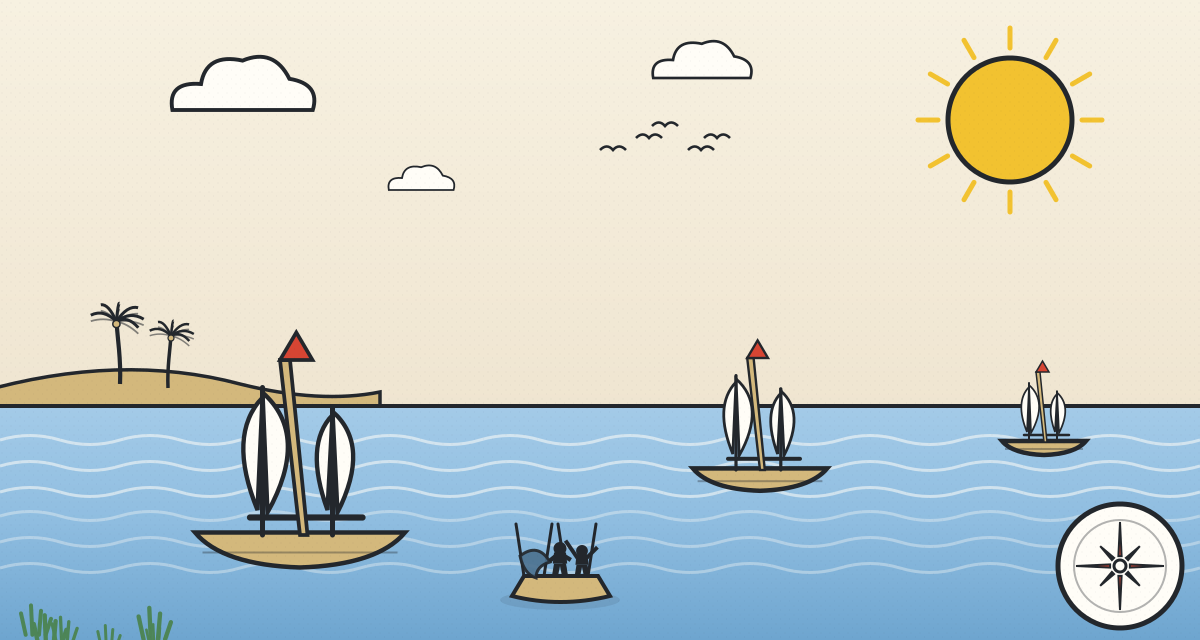
A free world history education, in the order it happened

The history of the entire world.

From hot dust to smartphones in one scroll — a free world history curriculum for students, teachers, and homeschool classrooms. Brisk, plain-spoken, and drawn with a marker. Start at the very beginning, or jump to any era.

Scroll down. The whole story is below.

A small blue planet with a moon and a satellite

Prologue · 13.8 billion years ago to 300,000 BCE

Before people: the rock, the water, the speck

Four and a half billion years of geology, oceans, and one very persistent molecule.

Start before there was anywhere to stand: no up, no down, no when. Then a great deal of energy went looking for a shape, and has been finding one ever since.

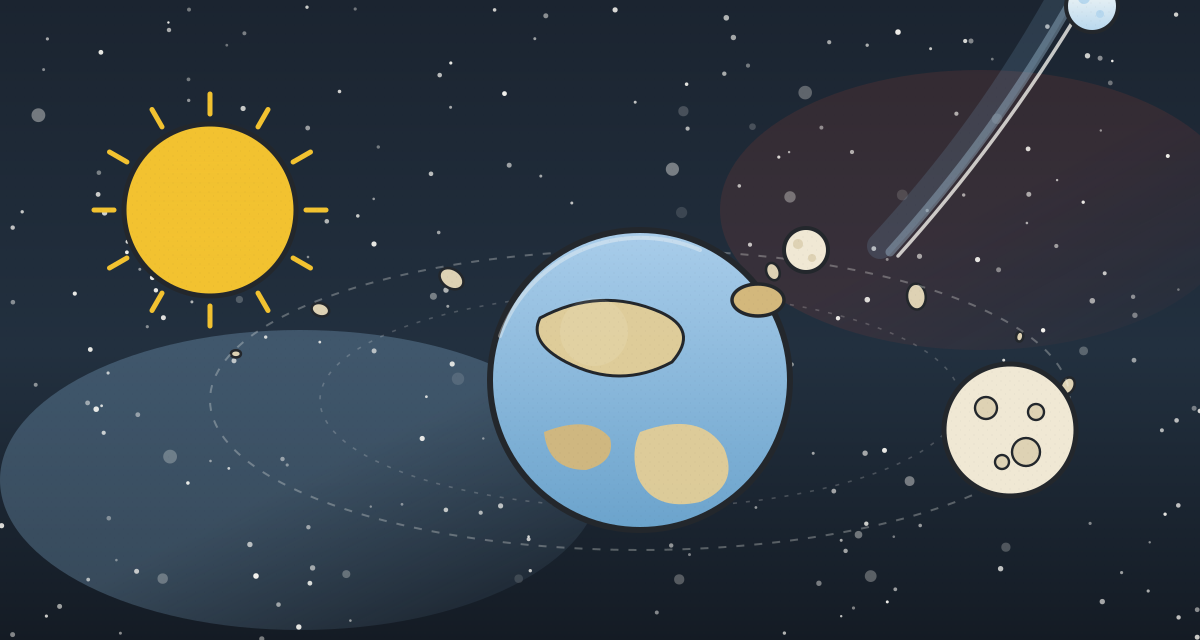
A young star, a forming planet with its moon, and a comet
Plate 1Roughly four and a half billion years ago, the dust around a young star began to clump.

Hot dust, meet cold water

Our planet assembled itself from the leftovers of a young star: grit, ice, and metal pulled together by gravity until the middle grew hot enough to melt. Early on, something about the size of Mars struck it a glancing blow, and the debris thrown into orbit gathered into the moon.1 For a long while the sky was full of falling stone, some of it carrying water; when that eased, steam condensed and the low ground filled up. The planet became an ocean interrupted by volcanoes. In that water, chemistry crossed a threshold: a molecule started copying itself, using instructions stored inside its own structure. That was the beginning of life, and it did not stop.2

The laser, the blanket, the egg

Some of those cells learned to harvest sunlight and released oxygen as waste. Over unimaginable stretches of time the atmosphere changed, the sky turned blue, and a layer of ozone formed high above the surface — which mattered, because until then dry land was bathed in hard ultraviolet light. With that shield in place, plants could spread onto the continents, and animals followed. The first land animals still had to return to water to breed; the solution was the shelled egg, a private pond carried inland. Freed from the shoreline, vertebrates radiated into every habitat, grew enormous, and for a while insects were the size of dinner plates. Then a rock from space ended the age of dinosaurs, the small warm-blooded survivors diversified, and one lineage learned to stand upright, carry tools, control fire, and speak. That lineage is us, and the rest of this page is its record.
Chapter one · 300,000–3000 BCE

Beginnings: first humans, first farms

For 290,000 years nobody wrote anything down — and then, in a few thousand years, everything changed.

Farming was a bargain, not a gift: it fed more people and demanded far more work from each of them.

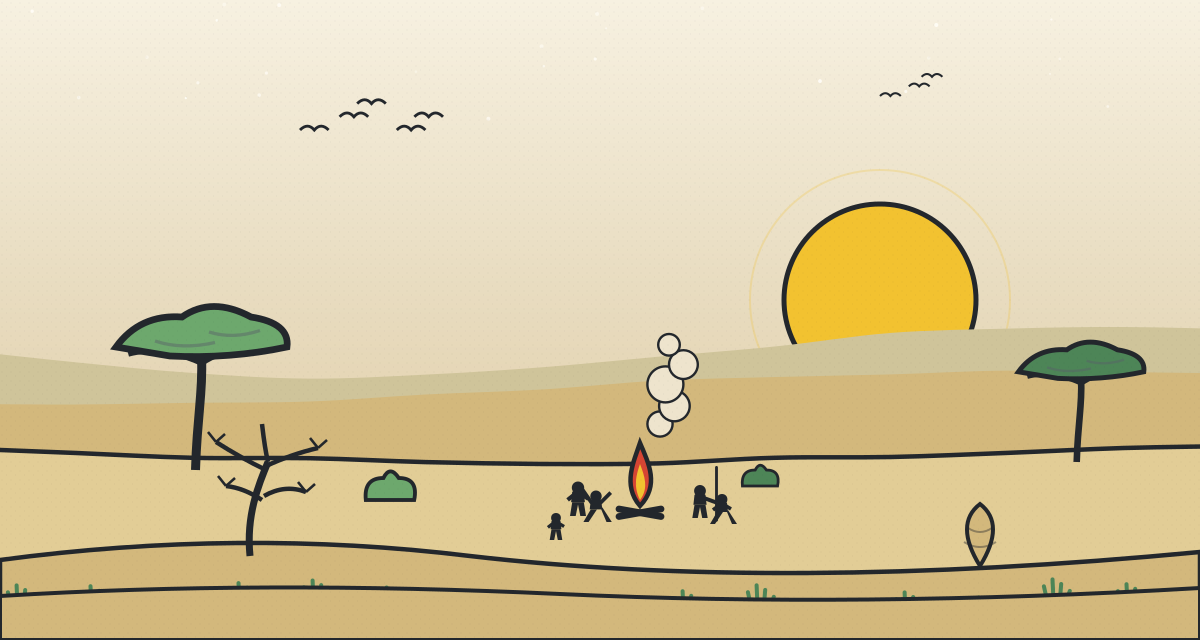
People gather at a fire on a dusk savanna
Plate 2Fire, a few tools, and a landscape that could be managed.

Out of Africa

Some three hundred thousand years ago, in what is now Morocco and East Africa, people anatomically like us were already knapping stone tools and controlling fire. Fire meant cooked food, and cooked food meant smaller guts and larger brains. Language — invisible to archaeology but betrayed by what followed — let bands of humans coordinate hunts, share knowledge, and remember the past out loud.

Beginning around 60,000 years ago, small groups walked out of Africa and into every habitable continent. They reached Australia by sea some 50,000 years ago, and the Americas, via the Bering land bridge, around 15,000 years ago. Every human alive today descends from those migrants.3 The cave paintings of Lascaux and Sulawesi, the carved lions and buried dead with red ochre, all whisper the same fact: these were symbolic minds, fully modern, living without cities, kings, or writing — and doing so for nearly all of human existence.

The farming gamble

Around 10,000 BCE, in the hills of the Fertile Crescent, people began deliberately planting wild wheat and barley and penning wild sheep and goats. It looks like progress — and in the long run it was — but for the first farmers it was a gamble that paid off in toil. Skeletons from early farming villages show worse nutrition, shorter stature, and more disease than their hunter-gatherer neighbours. Farming fed more mouths per acre, so populations grew, but each mouth worked harder.

What farming bought, slowly, was surplus: more food than the growers needed right now. Surplus could feed potters, priests, and soldiers — people who grew no food at all. Villages grew into towns. At Çatalhöyük in Anatolia, thousands lived cheek by jowl in mud-brick houses entered through the roof, burying their dead beneath the floors, centuries before anyone dreamed of a king. Complexity, it turns out, did not begin with empires.4

“Agriculture was the worst mistake in the history of the human race” — or its foundation. Both readings fit the same bones.After Jared Diamond’s famous provocation; the skeletons genuinely show declining health

Why this chapter matters

Everything after this chapter — cities, writing, empires, the device you are reading on — rests on the farming surplus. And the deep past sets the scale of the whole story: civilisation is roughly six thousand years old, a thin late chapter in a three-hundred-thousand-year book. Whenever later history feels inevitable, remember how long humans lived without any of it.

Examine the evidence

A house at Çatalhöyük, c. 7000 BCE

Archaeologists reconstruct one mud-brick room: platforms for sleeping, a hearth, a ladder-hole in the roof — and burials under the floor.

“The people of Çatalhöyük buried their dead beneath the floors and platforms of their houses, replastered skulls, and painted leopards and vultures on the walls above where they slept.”

Chapter two · 3500–1200 BCE

First cities: writing, law, and the Nile

History proper begins as bookkeeping — and rivers turn surplus into kingdoms.

Store grain and you must count it. Count it and you must write it down. Writing arrived as inventory, not as literature.

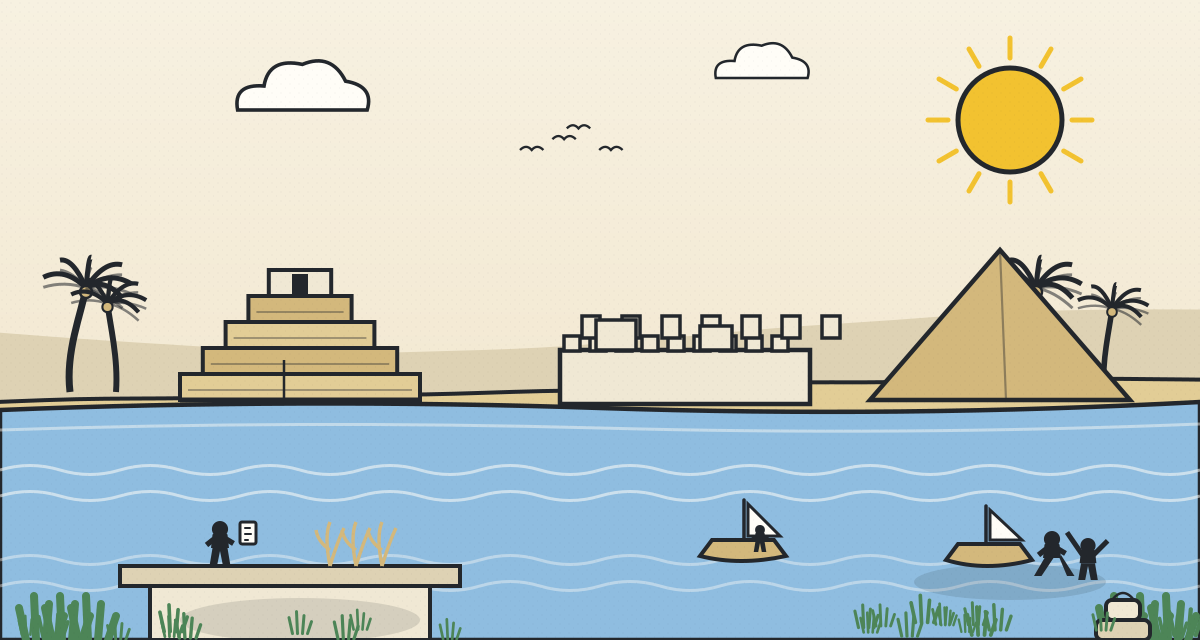
A river valley with a ziggurat, a pyramid, palms, and a scribe at work
Plate 3Mud brick, stepped platforms, and a river that paid for both.

Clay that remembers

Around 3200 BCE, in the Sumerian city of Uruk, a clerk pressed a reed stylus into wet clay to record sixty sheep owed to a temple. That tablet — a receipt, not a poem — is among the first writing on earth.5 Cuneiform began as pictures of things counted and slowly became signs for sounds, until anything said could be written. Egypt invented its own script, hieroglyphs, within a few centuries; the Indus cities used a script we still cannot read.

Notice what came first: not literature, but administration. Temples and palaces collected grain, paid labourers, and tracked debts, and writing was the tool that let them do it at scale. The Epic of Gilgamesh, the first great story, would come a thousand years later — bureaucracy invented the pen, and poets borrowed it.

Rivers of order

Egypt was, as Herodotus later said, the gift of the Nile. The river flooded every summer with metronomic reliability, laying black silt across the fields; the calendar, the taxes, and the king’s legitimacy all flowed from predicting it. A single kingship unified Upper and Lower Egypt around 3100 BCE and endured, with interruptions, for three millennia — the longest-lived state in human history. The pyramids of Giza, raised around 2560 BCE, were not built by slaves (the old story) but by rotating crews of fed, housed labourers: the flood season’s idle farmers put to work by a state that could organise tens of thousands.6

Meanwhile the Indus Valley built something stranger: Harappa and Mohenjo-daro laid out straight streets, covered drains, and standardised weights — urban planning without any palace, temple mound, or royal tomb yet found. Order, it seems, did not always need a king to impose it. And in Babylon, Hammurabi had his laws carved on black diorite for all to see: 282 judgments, an eye for an eye among equals, harsher for offences against superiors. Read it not as a record of trials but as a king advertising what justice should look like.7

“If a man destroy the eye of another man, they shall destroy his eye.”Hammurabi’s code, c. 1750 BCE — law as royal theatre as much as practice

The first collapse

Around 1200 BCE the Bronze Age world fell apart with terrifying speed: Mycenaean palaces burned, the Hittite Empire vanished, trade in tin — the scarce ingredient of bronze — seized up, and mysterious “Sea Peoples” raided the coasts. Egypt survived, barely. Writing disappeared from Greece for centuries. The lesson travels down the whole shelf: interconnected systems can fail together, and bronze itself — an alloy hostage to long-distance tin trade — was a fragility wearing a crown.

Examine the evidence

A Sumerian ration list, c. 3100 BCE

A clay tablet from Uruk: rows of impressed signs recording barley rations issued to workers — some of the oldest writing anywhere.

“32 measures of barley for 14 days — Kesh, the foreman, received. Seal of the temple household.”

Chapter three · 1200–500 BCE

Iron-age empires: Assyria, Persia, Zhou China

Cheap metal, cheap writing, and dear-bought lessons in how to rule millions.

Bronze depended on tin, and tin came from far away. Iron was underfoot — which changed who could arm an army.

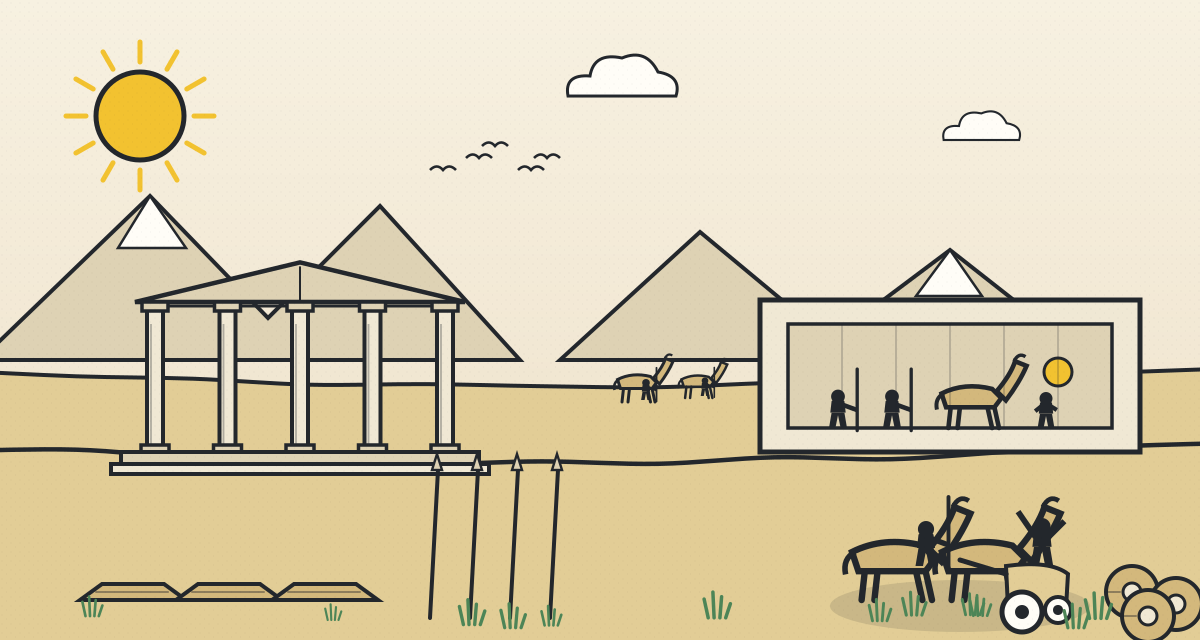
A temple colonnade, an Assyrian wall relief, iron ingots, spears, and a chariot
Plate 4Stone columns, horses, and a metal that was suddenly everywhere.

Iron for everyone

Bronze had a fatal weakness: tin. The metal that hardened copper into bronze came from a handful of distant mines, so bronze belonged to kings and their trade networks. Iron ore, by contrast, lies under half the earth. Once smiths learned to smelt it hot enough — around 1200 BCE in the Near East — any village with a furnace could forge tools and blades. Metal democratised, and with it, warfare: armies grew from chariot-riding elites into masses of iron-armed infantry.

Writing democratised too. The Phoenician merchants of the Levant, who needed quick tallies in foreign ports, stripped Egyptian hieroglyphs down to some twenty-two signs for consonants. The Greeks added vowels, the Romans adapted the Greek letters, and you are reading their descendant now. Traders carry ideas the way ships carry grain: the alphabet sailed with the merchants.

Terror and tolerance

Assyria showed one way to hold an empire: fear. Its armies were marvels of organisation — siege engines, cavalry, engineers — and its kings advertised flayings and deportations on palace walls so no province would need a second lesson. It worked for three centuries, until everyone Assyria had ever terrified united against it, and Nineveh fell in 612 BCE to enemies who left the city in ruins.

Persia, rising from Cyrus’s revolt in 550 BCE, chose the opposite wager. The Achaemenid Empire — Egypt to India, the largest the world had seen — ruled through satraps (provincial governors), the Royal Road with its relay stations, standardised tribute, and a deliberate tolerance:subject peoples kept their gods, customs, and laws. When Cyrus took Babylon, he presented himself as the restorer chosen by the local god Marduk. Terror extracts obedience for a season; administration extracts taxes for centuries.8

“I am Cyrus, king of the world… I entered Babylon in peace. I did not allow anyone to terrorise the land.”The Cyrus Cylinder, c. 539 BCE — propaganda, but propaganda of tolerance

The mandate above the king

Far east, the Zhou had solved the oldest problem of monarchy: what to do about a bad king. When they overthrew the Shang around 1046 BCE, they announced the Mandate of Heaven — rulers hold power only while they govern justly, and flood, famine, or tyranny signal that Heaven has withdrawn its favour. Rebellion against a failed dynasty was not treason but duty. Chinese dynasties would rise and fall against this doctrine for three thousand years: legitimacy with conditions, and an explanation of collapse built into the theory of rule itself.

Examine the evidence

Ashurnasirpal II boasts, c. 870 BCE

An Assyrian royal inscription from Nimrud, carved to commemorate a campaign — and to terrify readers.

“I flayed all the chiefs who revolted, and covered the pillar with their skins… Their corpses they hung on stakes upon the city wall.”

Chapter four · 500 BCE–500 CE

Classical worlds: Athens, Rome, Han, Maurya

Four civilisations, four answers to the same question: who gets to decide?

Four societies asked the same question — who should decide? — and produced four incompatible answers.

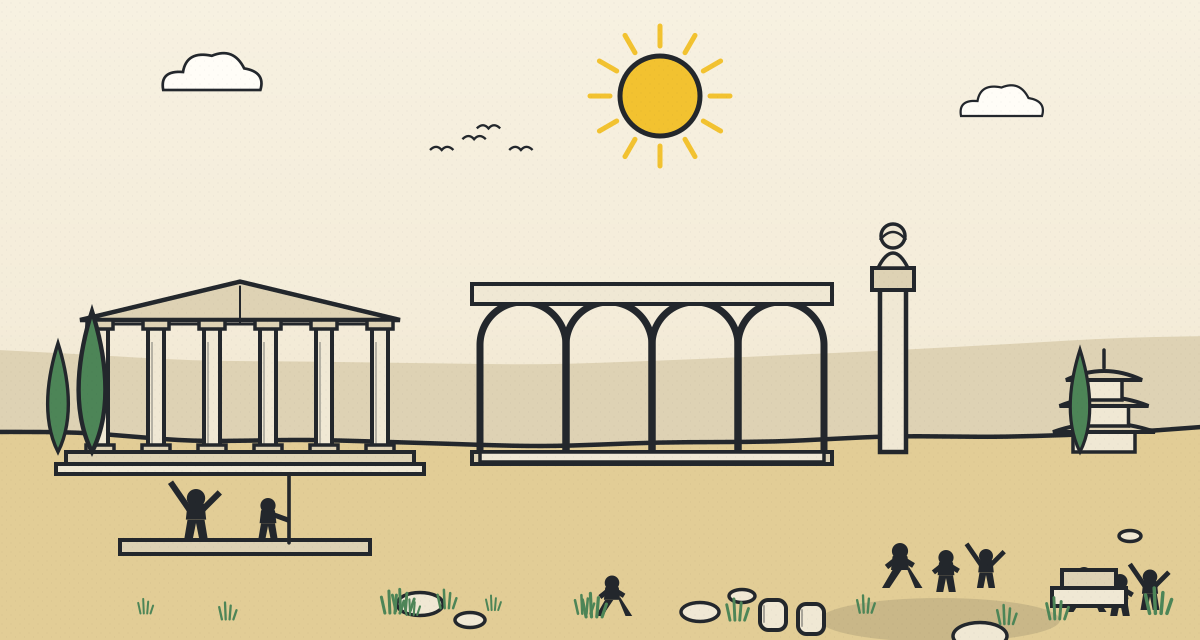
A Greek temple, a Roman aqueduct, an edict pillar, and a Han roof
Plate 5Temples, arches, and edicts carved for anyone who walked past.

The demos, narrowly defined

In 508 BCE, after expelling a tyrant, Athens reorganised its citizens into ten new tribes and began paying ordinary men to sit on juries and the council. Power — kratos — lay with the people — the demos. Assembly votes decided war, exile, and the budget; any citizen could speak. It was the most radical government on earth, and it excluded most of the people in it: women, the enslaved (perhaps a third of Attica), and resident foreigners could not vote. Athenian democracy was government by a minority that called itself everybody — ask who counts, in every age, before admiring the label.10

Rome answered differently: a republic of checks — consuls, Senate, assemblies, tribunes with vetoes — designed so no one man could rule. It worked until conquest broke it. Armies loyal to their generals, not the state, marched on Rome itself; a century of civil war ended when Augustus, Julius Caesar’s heir, gathered every power into one man’s hands while insisting the republic was restored. The empire that followed gave the Mediterranean two centuries of relative peace — the Pax Romana — at the price of liberty. Concrete domes, aqueducts, and law codes followed the legions; citizenship slowly widened until, in 212 CE, nearly every free man in the empire held it.

Examinations and edicts

While Rome professionalised power through law, Han China professionalised it through learning. From the second century BCE, officials were increasingly examined on Confucian texts rather than merely born into office — the seed of a system that would, in later dynasties, let a peasant’s son rise by examination essay. No other ancient state made book-learning the gate to government so explicitly.

And in India, the Mauryan emperor Ashoka did something no conqueror had done: after the bloody conquest of Kalinga, he had his remorse carved on rocks and pillars across the subcontinent. His edicts preach restraint, religious tolerance, respect for parents and servants, even kindness to animals — propaganda, certainly, but propaganda for gentleness, issued by a man with absolute power. Sources sometimes show rulers arguing with themselves; Ashoka argued in stone.9

“Beloved-of-the-Gods feels remorse on having conquered the Kalingas… the slaughter, death and deportation that occur when an unconquered country is conquered are considered extremely painful and deplorable.”Ashoka’s Major Rock Edict XIII, c. 260 BCE

Roads between worlds

These worlds were not sealed rooms. Silk reached Rome (which called China “Serica,” the land of silk) while Buddhism travelled the overland routes into China; glass, grapes, and grape-wine moved east as paper and peaches moved west. The Han envoy Zhang Qian returned in 126 BCE with reports of kingdoms all the way to Persia. Classical antiquity was already one connected argument about how to live together — conducted in Greek, Latin, Sanskrit, and Chinese.

Examine the evidence

Pericles’ funeral oration, as reported by Thucydides

Athens buries its war dead, 431 BCE. Thucydides admits he composed what Pericles “must have” said.

“Our constitution is called a democracy because power is in the hands not of a minority but of the whole people… every citizen, in whatever walk of life, can form a sound judgement on public affairs.”

Chapter five · 500–1200 CE

Faiths & trade roads: crosses, crescents, caravans

Two world religions and one long road system — and the cities where everything mixed.

Two faiths and one caravan network turned three continents into a single argument.

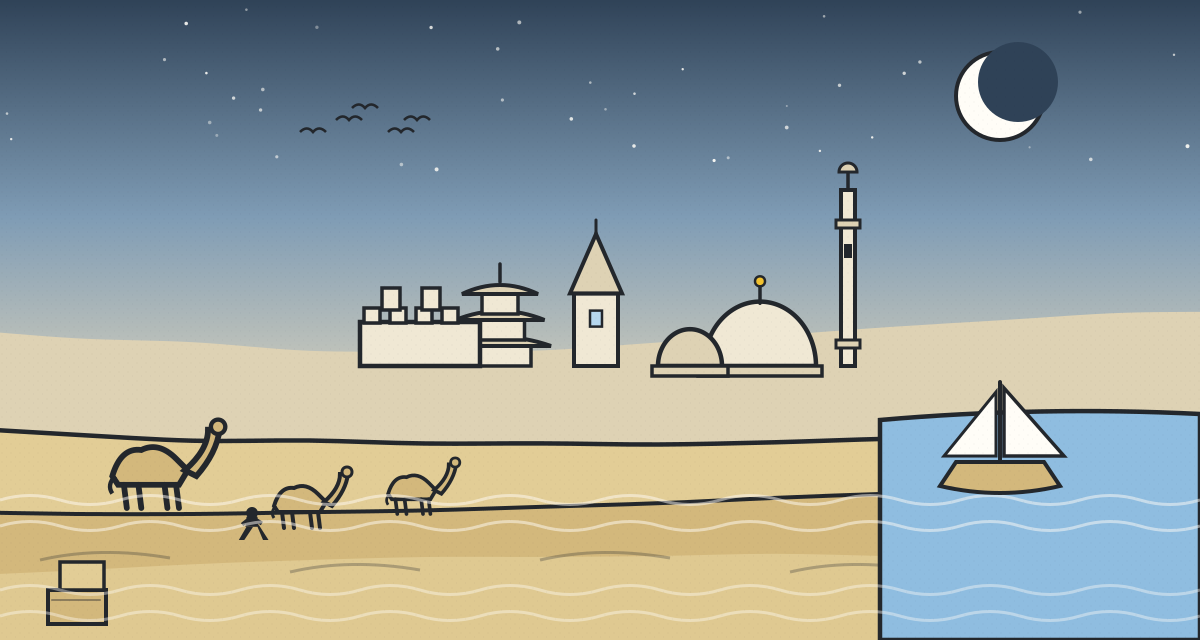
A camel caravan crossing dunes toward a dhow and a skyline of domes, spires, and roofs
Plate 6Caravans, coasting ships, and three faiths sharing a road.

Letters before legions

Christianity conquered no armies in its first three centuries; it had none. It spread the way gossip spreads: along roads and sea lanes, carried by merchants, soldiers, and enslaved people into the empire’s cities, organised by letters — Paul’s epistles are administration by post — and made attractive by charity that fed strangers during plagues when pagan priests fled. By 300 CE perhaps one in ten Romans called themselves Christian. Then Constantine, before a battle in 312, decided the Christian God backed winners. Imperial favour — money, basilicas, an end to persecution — did in a generation what three centuries of witness had prepared. Patronage transforms: approval can matter more than belief.

Islam moved faster still. From the Hijra in 622, Arab armies carrying a new revelation took Persia, the Levant, Egypt, North Africa, and Spain within a century — and the conquests hardened into something more durable than garrisons: one Arabic language of law and learning, one pilgrimage road to Mecca pulling scholars from three continents, and cities like Baghdad where translators rendered Greek philosophy, Indian mathematics, and Persian astronomy into Arabic side by side. When paper-making arrived from Central Asian prisoners in 751, the caliphate’s bureaucracy and book market drank it up; Cairo and Córdoba built libraries while much of Western Europe kept a few chained Bibles.12

The road that carried everything

The Silk Roads were never one road but a braided system of caravan tracks, sea lanes, and relay oases — and they carried ideas more consequentially than silk. Buddhism walked them into China, transforming both the faith and its host. Paper, gunpowder, and the compass travelled them west. Tang Chang’an, the world’s largest city around 750 with perhaps a million people, held Persian wine shops, Central Asian musicians, Nestorian churches, and mosques: a cosmopolitan capital is the fingerprint of open trade. Even diseases commuted — the plague of Justinian in the 540s likely rode these same routes, a rehearsal for worse to come.11

“The world has become one great market, and Baghdad its centre.”After the geographer al-Ya’qubi, c. 880 — a boast with receipts

The split that stuck

In 1054, Rome and Constantinople excommunicated each other over doctrine, leavened bread, and who commanded whom — the Great Schism. It might have healed, until the Fourth Crusade, bankrupt and diverted, sacked Christian Constantinople in 1204 and carried its treasures to Venice. Schisms have dates and deeds: 1054 drew the line, 1204 dug the trench. When Constantinople finally fell to the Ottomans in 1453, Moscow would call itself the Third Rome — the argument about who inherits an empire outliving the empire by centuries.

Examine the evidence

A Chang’an market inspector’s log, imagined from Tang records

Tang law codes and market registers describe the Eastern Market: 220 wards, licensed brokers, weights inspected by officials.

“Sogdian wine-sellers of the third row, Persian brokers of pearls, Uighur horse-dealers — all registered, all weighed, all taxed by the ward head before noon.”

Chapter six · 1200–1500

Mongols & plague: connection and catastrophe

The steppe unites the continent — and the germs ride along.

One empire made the trade routes safe. The same routes carried cargo nobody had ordered.

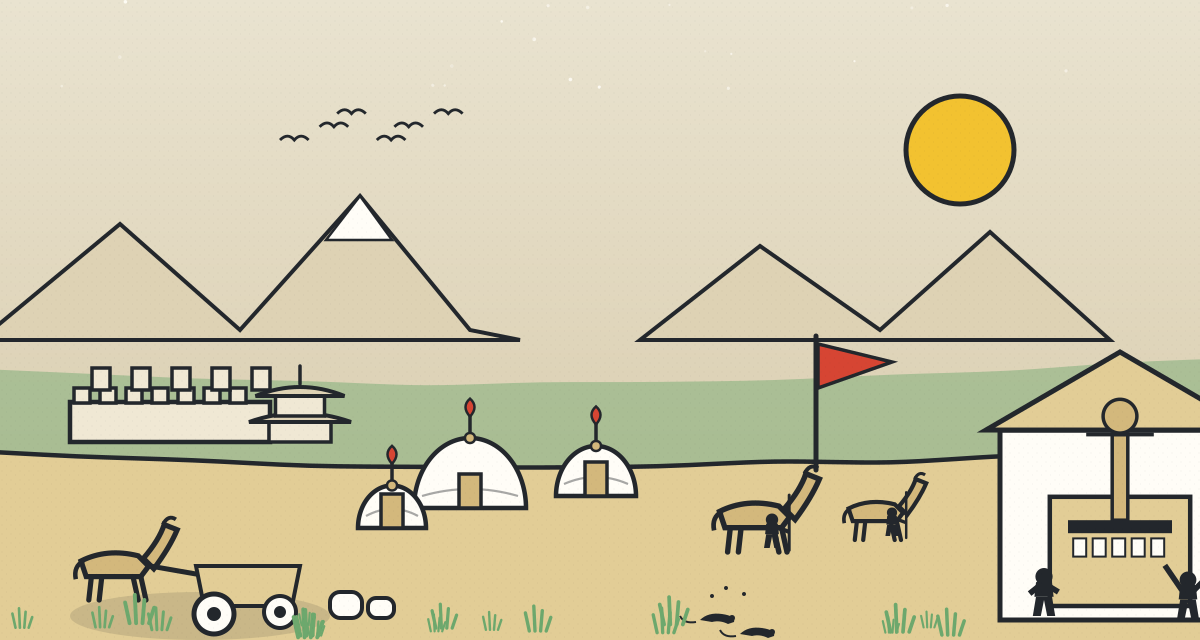
Yurts on the steppe, horsemen with a banner, and a printing press
Plate 7Felt tents on the steppe; a press in a German workshop.

The peace of the Khan

In 1206 a Mongol chieftain called Temujin was proclaimed Genghis Khan, and within two generations his heirs ruled from Korea to Hungary — the largest contiguous land empire in history. The conquests were apocalyptic for those in the way: Baghdad sacked in 1258, its libraries thrown in the Tigris; northern China devastated. But what followed was the Pax Mongolica: guarded caravan routes, relay stations with fresh horses every few dozen miles, passports stamped in gold, and envoys, merchants, and missionaries crossing the whole of Eurasia in relative safety. Marco Polo reached the court of Kublai Khan; Chinese engineers served in Persia; Persian astronomers worked in Beijing. Peace moves things — goods, envoys, ideas, and, unseen, germs.13

Not all connection was Mongol-made. In 1324 Mansa Musa, emperor of Mali, passed through Cairo on pilgrimage to Mecca trailing camels of gold, spending so lavishly he dented the Egyptian gold price for a decade. The spectacle announced West Africa to the Mediterranean: here was a centre of Islamic learning at Timbuktu, rich from trans-Saharan salt and gold, entirely outside the Mongol peace. The world had more than one network.

A third of Europe, gone

The plague bacillus travelled the Mongol roads west in fleas on rats in grain, reaching Crimea by 1346 and Sicily by 1347. What followed was the sharpest mortality event in recorded history: a third or more of Europe dead within five years, similar devastation in the Middle East and China. Villages emptied, fields went untilled, and the survivors inherited a remade world. Labour, suddenly scarce, grew dear: English peasants demanded higher wages, and when the crown tried to freeze pay, revolt followed — the Peasants’ Revolt of 1381 has the plague in its ancestry. Flagellants marched, pogroms blamed Jews, and the Church, which could neither explain nor stop it, lost some of the unquestioned authority it had held for centuries.14

“How many valiant men, how many fair ladies, breakfasted in the morning with their kinfolk and supped that night with their ancestors in the other world.”Boccaccio, Decameron, on Florence 1348 — literature as casualty report

The press that outran the fire

Around 1440, a Mainz goldsmith combined movable metal type, oil-based ink, and a wine-press mechanism — and information learned to multiply. Within fifty years, presses across Europe had printed millions of books: more than all the scribes of the Middle Ages produced in a millennium. When Luther’s theses sparked the Reformation in 1517, pamphlets carried the quarrel faster than bishops could burn them. Multiplication beats suppression: every later revolution of this shelf — scientific, industrial, political — runs on print’s rails.19

Examine the evidence

Ibn Battuta on the road, c. 1330

The Moroccan traveller describes crossing the whole Mongol peace, from Tangier toward China, under one system’s protection.

“Whoever travels with the Tatars through their lands is safe from robbery and violence, for the law punishes thieves with death — and relay horses stand ready at every station.”

Chapter seven · 1500–1800

The ocean age: exchange, enslavement, revolution

Sails wire the continents together — and the bill comes due in lives.

Ocean crossings reunited two branches of humanity that had been apart for fifteen thousand years. The reunion was not a fair one.

Tall ships crossing an open ocean beside a compass rose
Plate 8Three hulls, a compass, and an ocean that stopped being a wall.

Two worlds, one exchange

In 1492 Columbus, sailing for Spain toward Asia, fetched up in the Caribbean instead — and two halves of the human species, separated for fifteen thousand years, were suddenly one trading zone. What crossed the Atlantic remade both shores. West to east went potatoes, maize, tomatoes, tobacco, and American silver, which financed Spain’s empire and oiled China’s tax system. East to west went wheat, horses, and — most murderously — smallpox, measles, and influenza, to which Indigenous peoples had no immunity. Germs before guns: disease killed perhaps nine in ten Native Americans in the first century of contact, emptying lands Europeans then called wilderness.

The cruellest cargo ran east to west across a second ocean. To work American plantations after Indigenous labour collapsed, European traders bought — and African states sold — millions of captives across the Atlantic. Twelve million crossed; perhaps two million died on the voyage. The sugar, tobacco, and cotton they grew under the lash funded banks, ports, and industries in Liverpool, Nantes, and Amsterdam. Follow the labour: the wealth of the Atlantic world rests on enslavement, and every ledger of “trade” from these centuries has shackles in the margin.15

Test it yourself

While empires counted silver, a quieter revolution counted evidence. Galileo pointed a telescope at Jupiter’s moons and saw not perfect heavens but data; Bacon preached experiment over Aristotle; and in 1687 Newton showed that one mathematics — gravitation — ruled falling apples and orbiting moons alike. The method was the message: observe, measure, predict, repeat, and let no text, however ancient, overrule the result. Print’s rails carried it everywhere: scientific journals, academies, and correspondence networks made discovery cumulative for the first time. Nature became legible — and, soon, exploitable at industrial scale.

“We hold these truths to be self-evident, that all men are created equal.”The American Declaration of Independence, 1776 — written by an enslaver, read ever since against its authors

Liberty, unequally applied

The revolutions that closed this chapter spoke in universals and acted in particulars. America’s founders proclaimed equality while protecting slavery; France’s National Assembly declared the Rights of Man while the sugar colonies ran on enslaved labour — until the enslaved of Saint-Domingue seized the promise literally and made the Haitian Revolution (1791–1804), the only successful slave revolt in history, founding Haiti at terrible cost. Principles meet interests: every universal of this age must be checked against the plantation. The ideas survived their authors’ hypocrisy precisely because the excluded could quote them back.16

Examine the evidence

A slave ship’s manifest, Liverpool, 1780s

Business papers recorded human beings as units: age, height, “condition” — and the arithmetic of the Middle Passage.

“Shipped on the good ship Brooks: 450 souls, tons burden 320. Mortality on passage: 74. Sold at Kingston for £28 per head.”

Chapter eight · 1800–today

The modern world: industry, empire, and after

Coal, colonies, catastrophe — and the unwinding that made the present.

Steam did more than drive machines. It rearranged which nations could dominate which.

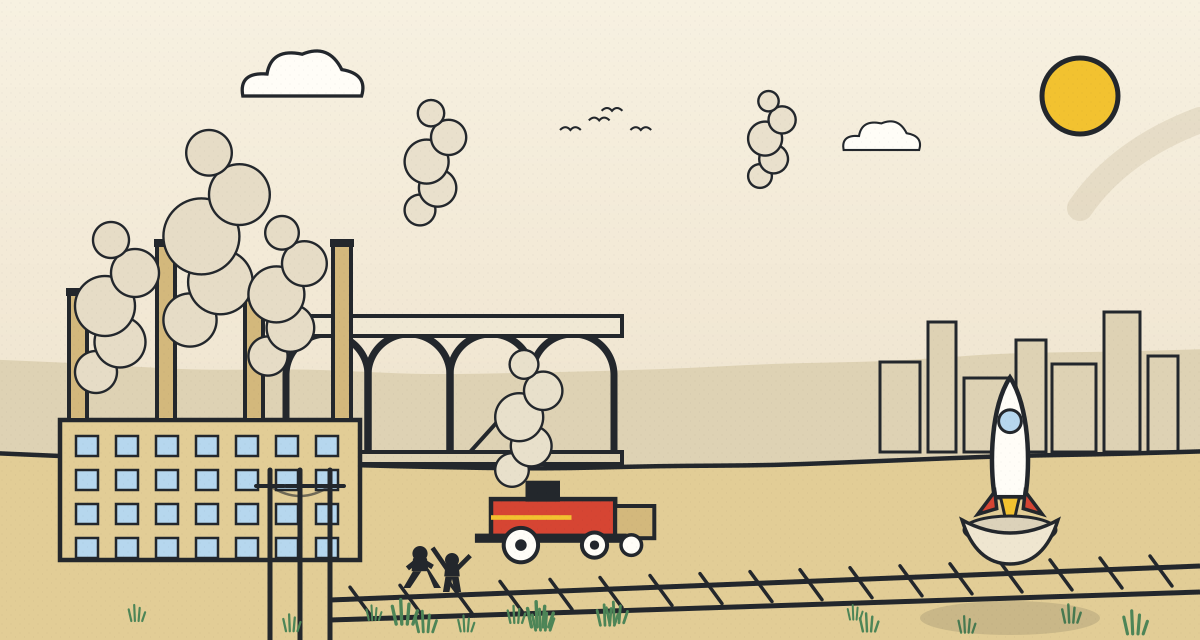
A coal factory, a steam locomotive on rails, and a rocket climbing out
Plate 9Chimneys, rails, and a machine that left the atmosphere.

The furnace lights

Around 1800, Britain began burning coal to spin cotton, pump mines, and drive looms — and output per worker broke from every historical ceiling. Why there first? Accessible coal, capital pooled from Atlantic trade, expanding markets, and a patent system that let tinkerers profit. The formula copied fast: railways, steamships, telegraphs, and factories remade every society they touched. Industrial power also remade war and empire — gunboats and railways let a small island administer a quarter of humanity, and the Scramble for Africa carved a continent at a Berlin conference table in 1884 with barely an African present.17

No single cause lit the furnace; coal plus capital plus markets did. And the furnace had a chimney: by 1900 coal smoke, colonial extraction, and breakneck urbanisation had already written the first drafts of our climate and inequality crises. Maps tell the story — 1914 Africa is nearly all colony, and 1914 Europe is an armed camp of alliances, timetables, and dreadnoughts waiting for a spark.

The wars that made the states

The First World War escalated because systems outran diplomacy: interlocking alliances, mobilisation timetables that punished delay, and empires that turned a Balkan assassination continental. Ten million soldiers died; three empires — Russian, Austro-Hungarian, Ottoman — collapsed outright. Russia’s collapse opened the door to 1917: war, hunger, and a disciplined Bolshevik minority made the first communist state, which would shape the century’s second half.

The Depression then showed what connection transmits: American banks fell, war debts defaulted, the gold standard seized, and unemployment marched worldwide — discrediting democracies and feeding fascists who promised order. The Second World War that followed killed perhaps seventy million, industrialised genocide included, and ended with the atomic bomb over Hiroshima and Nagasaki: war had learned to end cities in a flash, and everyone understood the next great-power war might end everything.18

“Never in the field of human conflict was so much owed by so many to so few.”Churchill on the Battle of Britain, 1940 — rhetoric as policy, holding a country together by sentence

Empires unwind, bombs keep the peace

After 1945 the colonial empires could no longer afford themselves — bankrupted by war and pushed by anti-colonial movements from Accra to Hanoi, they unwound with astonishing speed: India and Pakistan in 1947, dozens of African states around 1960. Agency plus exhaustion: the colonised pushed, and the metropoles could no longer hold.

Meanwhile the United States and the Soviet Union, each armed with weapons that made direct war suicidal, conducted their rivalry through proxies, spies, space races, and Olympic medal tables. The Cold War stayed cold where it mattered because the bomb moved war to the margins — Korea, Vietnam, Afghanistan bled instead. When the Soviet Union dissolved in 1991, the American-led order of markets, container ships, and the early internet inherited the earth. The shelf ends here, with you: the present is just the top layer of the excavation, still being laid down.

Examine the evidence

A Berlin Conference map, 1885

Europe’s diplomats drew lines across Africa in coloured pencil — rivers as rulers, kingdoms as blank space.

“The Congo Free State — personal property of Leopold II, King of the Belgians. Population consulted: none. Treaties signed with marks, at gunpoint, in languages the signers could not read.”

The lamp stays on

You have read the whole thing. If a name or date slips past, the reading guide, glossary, and citations shelf are on the desk beside you.