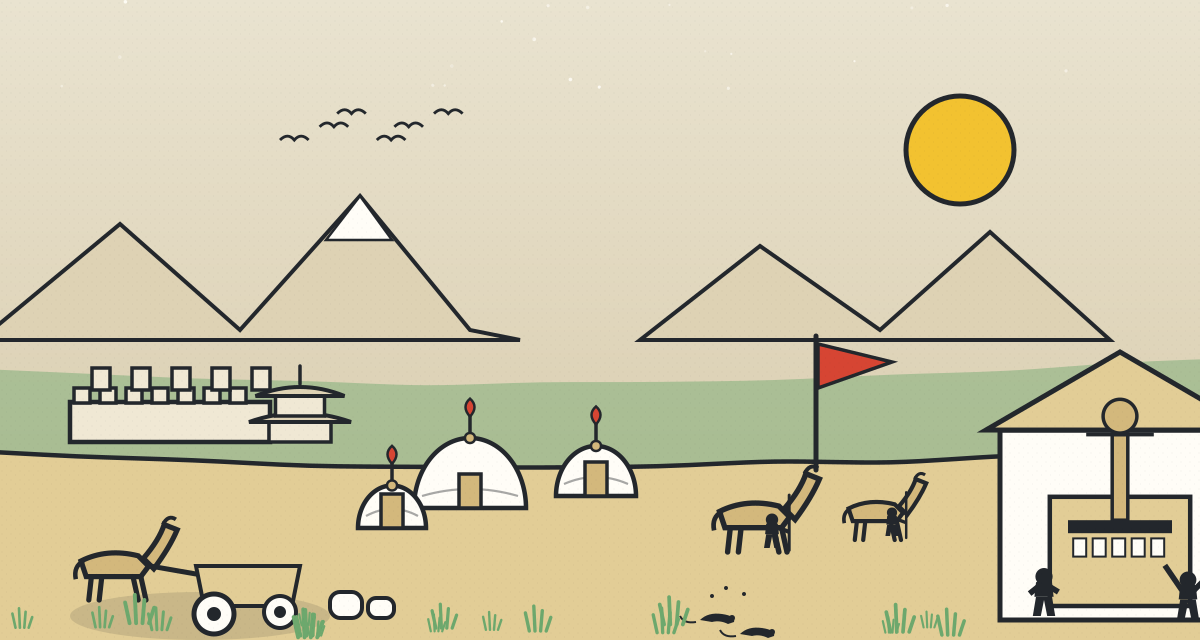
The peace of the Khan
In 1206 a Mongol chieftain called Temujin was proclaimed Genghis Khan, and within two generations his heirs ruled from Korea to Hungary — the largest contiguous land empire in history. The conquests were apocalyptic for those in the way: Baghdad sacked in 1258, its libraries thrown in the Tigris; northern China devastated. But what followed was the Pax Mongolica: guarded caravan routes, relay stations with fresh horses every few dozen miles, passports stamped in gold, and envoys, merchants, and missionaries crossing the whole of Eurasia in relative safety. Marco Polo reached the court of Kublai Khan; Chinese engineers served in Persia; Persian astronomers worked in Beijing. Peace moves things — goods, envoys, ideas, and, unseen, germs.13
Not all connection was Mongol-made. In 1324 Mansa Musa, emperor of Mali, passed through Cairo on pilgrimage to Mecca trailing camels of gold, spending so lavishly he dented the Egyptian gold price for a decade. The spectacle announced West Africa to the Mediterranean: here was a centre of Islamic learning at Timbuktu, rich from trans-Saharan salt and gold, entirely outside the Mongol peace. The world had more than one network.
- 1206 Temujin proclaimed Genghis Khan
- 1258 Mongols sack Baghdad
- 1271–1295 Marco Polo’s journey to China
- 1324 Mansa Musa’s pilgrimage passes Cairo
- 1347–1352 The Black Death ravages Europe and Asia
- c. 1440 Gutenberg’s movable-type press
A third of Europe, gone
The plague bacillus travelled the Mongol roads west in fleas on rats in grain, reaching Crimea by 1346 and Sicily by 1347. What followed was the sharpest mortality event in recorded history: a third or more of Europe dead within five years, similar devastation in the Middle East and China. Villages emptied, fields went untilled, and the survivors inherited a remade world. Labour, suddenly scarce, grew dear: English peasants demanded higher wages, and when the crown tried to freeze pay, revolt followed — the Peasants’ Revolt of 1381 has the plague in its ancestry. Flagellants marched, pogroms blamed Jews, and the Church, which could neither explain nor stop it, lost some of the unquestioned authority it had held for centuries.14
The press that outran the fire
Around 1440, a Mainz goldsmith combined movable metal type, oil-based ink, and a wine-press mechanism — and information learned to multiply. Within fifty years, presses across Europe had printed millions of books: more than all the scribes of the Middle Ages produced in a millennium. When Luther’s theses sparked the Reformation in 1517, pamphlets carried the quarrel faster than bishops could burn them. Multiplication beats suppression: every later revolution of this shelf — scientific, industrial, political — runs on print’s rails.19